Information for institutional quotation
LL37: price, documentation and dispatch in Colombia
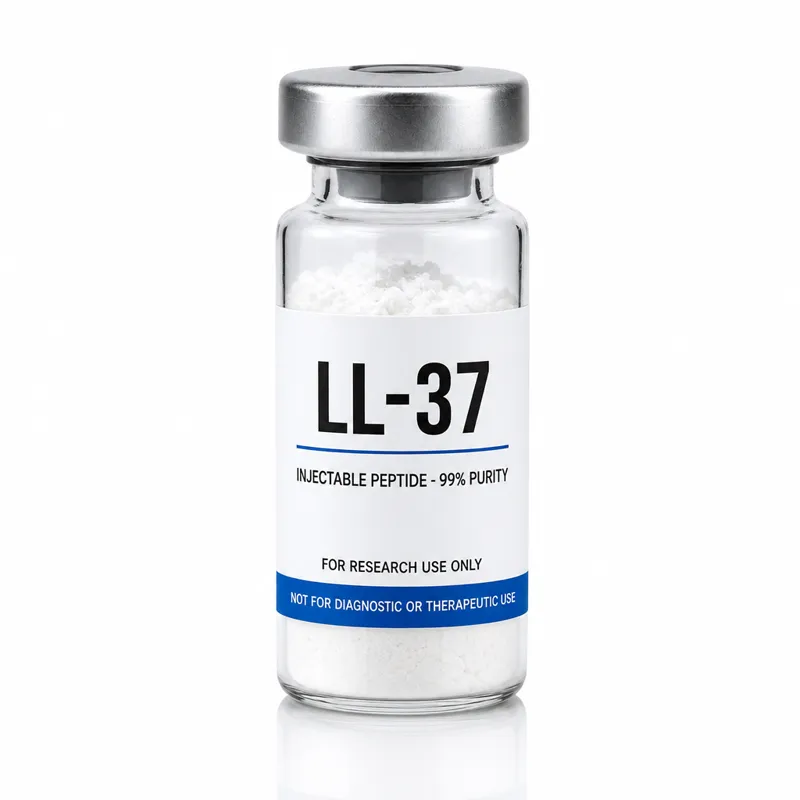
LL37 is listed in this catalog as a peptide reference intended exclusively for research and laboratory work, classified as a 37-amino-acid peptide derived from human cathelicidin. Within the immunomodulation, longevity, and cellular metabolism category — one of the catalog's largest groupings — it is one of the longest peptide chains declared in that category. This page brings together the available presentation, the current price shown in the commercial block, and the documentary conditions for an institutional quote. The identity and purity of the lot are never assumed from its length or its declared origin; they are confirmed by the certificate of analysis Janoshik Analytical issues per lot, using HPLC for purity and mass spectrometry for identity. This page explains what deriving from a human protein involves and how LL37 is positioned relative to shorter peptides in the same category.
Presentations and visible prices
| Presentation | Code | Reference price |
|---|---|---|
| 5mg | 375 | US$185 |
The price above is the public value per vial. Availability and batch documentation are confirmed before the quotation is accepted.
37 amino acids: the longest peptide in this category
The catalog classifies LL37 as a 37-amino-acid peptide, one of the longest chains declared within the immunomodulation, longevity, and cellular metabolism category, which brings together fifteen references from different molecular families. Epitalon has four amino acids, Vesugen three, and SS-31 is a four-amino-acid tetrapeptide; NAD+, for its part, is not a peptide at all. That length comparison is a verifiable structural fact, useful for understanding that 'the same commercial category' does not imply chains of similar size.
A 37-amino-acid chain is considerably more complex to synthesize and to verify analytically than a short three- or four-amino-acid peptide. This page does not describe that synthesis process or its degree of difficulty; it is limited to declaring the chain length as part of the verified structural classification for this reference.
Derived from a human protein: what this means documentarily
The catalog declares that LL37 is derived from human cathelicidin, a family of proteins naturally present in the human body. This origin data point is different from the porcine origin declared for Cerebrolysin, another reference in this same catalog: in one case the reference biological origin is human, and in the other, porcine. Both are classification facts, not descriptions of a specific analytical lot.
That LL37 derives from a human protein does not mean the dispatched material comes directly from human tissue: the catalog does not declare that manufacturing-process fact, and this page does not fill it in by analogy with other references. If the purchasing institution needs to know the production process for the synthetic material, it should request it through the site's institutional channel.
The 5mg presentation and what that means in powder form
LL37 is offered in a single presentation of 5 mg, measured by mass, which corresponds to a lyophilized powder in a vial under the criterion the catalog applies. With no milligram variants, the institutional request focuses on a single reference code, with the current price shown in the commercial block of this page.
This presentation's price should always be confirmed in the page's commercial block before approving the quote, without assuming it matches another reference in the same category or a previous inquiry. That written confirmation is what should be recorded in the purchase file, not a figure recalled from memory.
Janoshik's COA for a longer peptide
LL37's certificate of analysis is issued by Janoshik Analytical, per lot, using HPLC for purity and mass spectrometry for identity, the same procedure applied to short-chain peptides in the catalog. For a 37-amino-acid chain, confirming full identity through mass spectrometry is a relevant control, since an incomplete synthesis could produce shorter fragments than the declared peptide.
Neither the purity percentage, the CAS number, the molecular formula, nor the molecular weight of LL37 appear on this page: they are not verified in the documentation available to the page, and filling them in by resemblance to another peptide in the category would mean inventing them. The COA is provided on request and subject to documentary availability.
Storing LL37 within the same range as the rest of the catalog
The 37 amino acids do not change the custody criterion: the lot's document governs. When that document calls for 2-8 °C and protection from light, that condition should be operational at the receiving institution before the package arrives, with the lot already logged internally.
LL37 is handled on a made-to-order basis, with a 15-day coordination window declared in the catalog. Shipping fees for Bogota and for destinations outside Bogota are set out on the site's shipping information page; the delivery timeframe is confirmed at the time of the quote, not on this page. Outside Colombia, this reference ships to 5 countries (Costa Rica, Ecuador, United States, Mexico and Puerto Rico), from US$57; the rate for each country is listed on the site's international shipping page.
Its place among the short peptides in the same category
Within the immunomodulation, longevity, and cellular metabolism category, LL37 is distinguished from Epitalon, SS-31, and Vesugen by its chain length, and from NAD+ by being a peptide versus a coenzyme that is not one. Documenting these differences precisely helps an institution comparing several references in this category understand that a shared commercial grouping does not equal a shared structural classification.
The request is recorded first, then the quote is confirmed in writing, and only at the end is payment coordinated. The recommended file brings together those documents with dispatch confirmation, the receiving record, and Janoshik's lot certificate, when one was requested.
Frequently asked questions about LL37
How many amino acids does LL37 have?
The catalog classifies it as a 37-amino-acid peptide derived from human cathelicidin, one of the longest chains declared within its category, which groups fifteen references from different families.
What does it mean that it derives from human cathelicidin?
That its declared structural classification associates it with that family of human proteins. It is a classification fact, distinct from the porcine origin declared for other catalog references such as Cerebrolysin.
Who certifies LL37's lot?
Janoshik Analytical, per lot, using HPLC for purity and mass spectrometry for identity. The certificate is arranged on request and subject to documentary availability.
How is LL37 stored?
Per the documentation applicable to the lot. If it specifies 2-8 °C and protection from light, that condition should be built into the laboratory's custody setup before receiving the package.
Does Janoshik's certificate confirm LL37's full 37-amino-acid sequence?
The COA uses mass spectrometry for identity and HPLC for purity, per lot. That is the mechanism confirming the dispatched material corresponds to the full declared peptide and not an incomplete synthesis; it is arranged on request and subject to documentary availability.