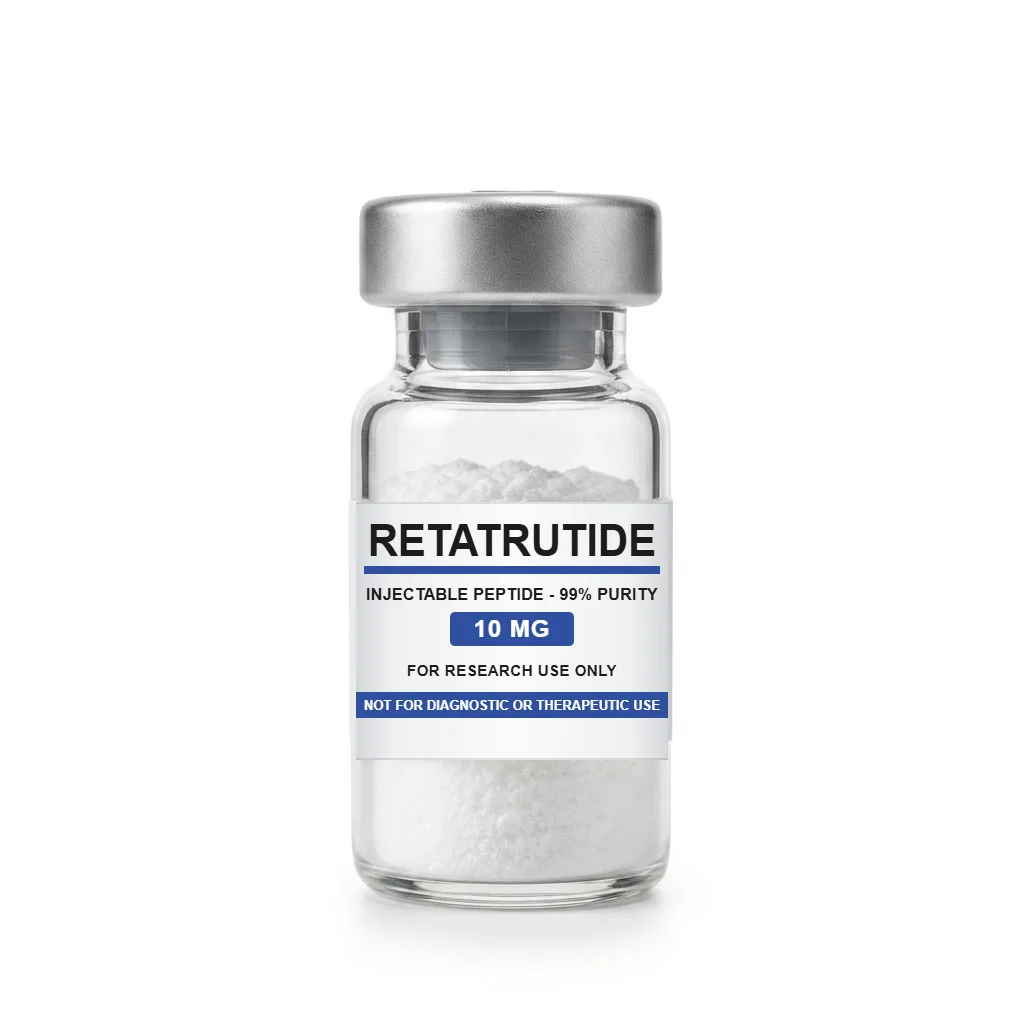
Information for institutional quotation
Retatrutide: price, documentation and dispatch in Colombia
Retatrutide is listed in this catalog as a peptide reference intended exclusively for research and laboratory work. In terms of molecular classification, Retatrutide is a synthetic triple agonist of the GLP-1, GIP, and glucagon receptors. This page organizes the information an institution needs before requesting a quote in Colombia: unambiguous identification of the reference, available presentation, batch documentation, declared storage conditions, logistics costs, and confirmation steps. The current price and presentation appear next to the product, so the decision does not depend on a figure copied into a text that may go out of date. The listing does not substitute for the buyer's own document review, nor does it propose any use outside the research setting. Its purpose is to make a verifiable purchase possible, with concrete questions and a clear record of what has been confirmed and what still needs validation.
Presentations and visible prices
| Presentation | Code | Reference price |
|---|---|---|
| 5mg | RT5 | US$85 |
| 10mg | RT10 | US$130 |
| 15mg | RT15 | US$170 |
| 20mg | RT20 | US$200 |
| 30mg | RT30 | US$276 |
| 60mg | RT60 | US$488 |
The price above is the public value per vial. Availability and batch documentation are confirmed before the quotation is accepted.
Identify the reference before requesting a quote
An institutional request should start with the exact name Retatrutide and the presentation shown as available on the page. It is not advisable to request only "the peptide" or to carry over data from another reference, because each catalog entry has its own price, presentation, and batch documentation. The safest way to open the commercial conversation is to copy the visible name, state the number of units required, and identify the request as laboratory work, without describing the experimental design. That precision reduces later corrections and lets the quote be tied to the correct item from the first exchange.
The commercial identity shown in the catalog is a starting point, not a substitute for analytical evidence. Before accepting the product, the buyer must check the label and the batch certificate against the reference requested. If the name, presentation, or batch identifier do not match between the documents and the material received, the discrepancy must be recorded and resolved before the unit is added to inventory. This discipline matters especially when an institution manages several peptide references with similar packaging.
What to check on the certificate of analysis
Purity and identity should not be assumed from a page's general text. They can only be reviewed on the certificate of analysis, or COA, corresponding to each batch. Access to the COA is provided on request and subject to document availability. When available, it is worth verifying that it includes a legible batch identifier, that the reference name matches Retatrutide, and that the reported results are attributed to that same documentary unit. An isolated figure, a screenshot with no batch reference, or a certificate from a different production run do not allow the traceability review to be closed.
If the COA is available, the responsible team can keep it together with the purchase order, the accepted quote, and the receiving record. It should also note the date the document was received and who carried out the review. This file does not need to interpret more than what the certificate states: its function is to show what evidence accompanied the batch and when it was assessed. If a relevant data point is missing, the correct approach is to mark it as pending and request clarification, not to fill it in with information from the internet or another supplier's specifications.
Receiving and internal traceability
An orderly receiving process starts by comparing the confirmed quote against the material's label; if document availability allowed it, the supplied COA is checked as well. The internal record should keep the name Retatrutide, the presentation received, the number of units, the visible batch identifier, and the intake date. If the institution uses its own inventory codes, these can be added without concealing the original code. This preserves a documentary path from the request through to the material's final location inside the laboratory.
It is also useful to record the external condition of the packaging and any discrepancy observed when opening the shipment. An anomaly does not by itself prove a defect in the contents, but it does call for setting the unit aside and asking before releasing it into the workflow. Warranty terms are governed by the conditions published at the site's specific link; the buyer should review that document and keep evidence of the case. This page does not expand or modify those conditions.
Declared storage and environmental control
If the applicable batch documentation declares storage in the 2-8 °C range with protection from light, the institution must prepare a compatible space before the order arrives and avoid leaving the material without control while the intake record is completed. That condition is not assumed for every batch: it must be verified in the available documentation. It is worth identifying the assigned location, confirming that its monitoring is active, and limiting handling to authorized personnel. Temperature logging belongs to the buyer's own quality system and should not be replaced by a subjective impression from touching the package.
Transport conditions should be discussed during the quoting process, especially if the route originates outside Bogotá or if receiving occurs outside normal hours. This page does not state a specific logistics method or an undocumented thermal performance. The buyer can ask that the commercial confirmation detail the shipping method, the delivery point, and any declared protective measure. On receipt, the buyer should record the time and the observable conditions without inferring data that were not actually measured.
Shipping costs and lead times, without promises
Current rates for shipping to Bogotá and elsewhere in the country are listed on the site's shipping information page. That logistics amount must be added to the current price of the presentation and the number of units requested to reach the quote's total. If there are multiple addresses, partial deliveries, or special receiving requirements, a specific confirmation must be requested before payment. A general rate should not be read as automatic coverage for additional conditions. Outside Colombia, this reference ships to 5 countries (Costa Rica, Ecuador, United States, Mexico and Puerto Rico), from US$57; the rate for each country is listed on the site's international shipping page.
Delivery times are not confirmed on this page and are set when the quote is issued. The date the laboratory needs should be communicated as a requirement, not treated as a promise already accepted. The final quote should state when the order can ship or what information is still needed to establish that. This transparent approach avoids publishing timelines that shift with inventory, destination, or logistics coordination, and lets the institution decide with the information that is actually available.
Institutional purchase workflow
The recommended workflow is short and auditable: select the presentation shown, state the number of units, confirm the destination and institutional address, request the COA on request and subject to document availability, and ask for the consolidated total. After reviewing the response, the buyer can confirm the order. The payment method and the total are fixed in writing in the accepted quote. Before paying, the reference, quantity, shipping cost, and total must all match. Any change requires a new written confirmation.
Retatrutide is offered here for research use only. The catalog is limited to sourcing information, documentation, and custody. A responsible institutional purchase keeps the commercial decision separate from the definition of the experimental work: it first establishes what material is being acquired and how it will be stored, then applies the laboratory's own approved and documented procedures. The party issuing the quote can resolve availability and commercial documents, but does not define experimental applications and does not replace the institution's internal review.
Checklist for approving the order
Before approving, the person responsible can answer seven questions: is the exact name Retatrutide? does the presentation match the institutional need? was the visible price confirmed? does the COA, if available, correspond to the batch offered? does the applicable batch documentation declare storage between 2 and 8 °C with protection from light? was shipping calculated for the correct destination? was the lead time confirmed in the quote? If any answer is negative or unknown, the order still has an open point.
After delivery, the same list serves as a closing check: reconcile units, labels, batch, documentation, and the intake record. Keeping these elements makes it possible to reconstruct the purchase without relying on personal memory or scattered messages. The goal is not to add bureaucracy, but to prevent a research reference from entering inventory with ambiguous identity, conditions, or documentary origin. The page provides the structure; final acceptance always depends on the evidence for the batch actually offered and received.
Frequently asked questions about Retatrutide
Is Retatrutide offered for research use?
Yes. This reference is listed exclusively for research and laboratory work. The page is limited to identification, purchasing, documentation, receiving, and custody. The purchasing institution must apply its own approval and control processes.
How is Retatrutide technically different from Tirzepatide?
The difference described here is limited to molecular classification: Retatrutide is a synthetic triple agonist of the GLP-1, GIP, and glucagon receptors, while Tirzepatide is a synthetic dual agonist of the GLP-1 and GIP receptors. Both references are offered exclusively for research and laboratory use.
Where can batch purity and identity be confirmed?
They can only be reviewed on the COA corresponding to the batch offered and should not be inferred from a general description. Access to the certificate is provided on request and subject to document availability. If supplied, it should match the material received in name and identifier.
What is the declared storage condition?
The 2 to 8 °C condition with protection from light only applies if the applicable batch documentation declares it. The buyer must verify that documentation, set up the indicated space before receiving, and keep its own record in line with the laboratory's procedures.
How much does shipping within Colombia cost?
Current rates for shipping to Bogotá and elsewhere in the country are listed on the site's shipping information page. For specific addresses, quantities, or special conditions, the total must be confirmed in writing within the quote before payment. Outside Colombia, this reference ships to 5 countries (Costa Rica, Ecuador, United States, Mexico and Puerto Rico), from US$57; the rate for each country is listed on the site's international shipping page.
How long does the order take to arrive?
Lead times are not confirmed on a general basis and are set when the quote is issued. Inventory, destination, and receiving coordination can affect them. A date should only be considered agreed once it is explicitly stated in the commercial confirmation.
How is payment handled?
Payment is coordinated after confirming, in writing, the reference, presentation, units, destination, shipping cost, total, and the payment method to be used. If any of those elements changes, an updated confirmation must be requested before paying.
What should I do if the batch does not match the COA?
Set the unit aside from available inventory, keep the packaging and receiving evidence, and request clarification before using it in any work. Warranty terms are found at the specific link published on the site.