Information for institutional quotation
L-carnitine: price, documentation and dispatch in Colombia
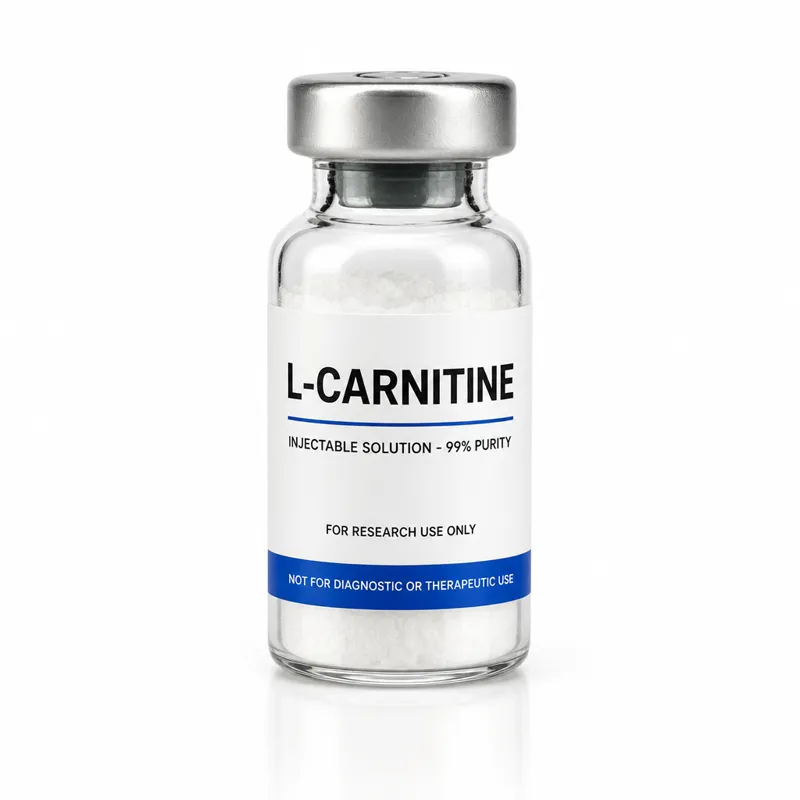
L-Carnitine is the only reference with a declared chemical composition within the diluents and laboratory-supplies theme group: it is an amino-acid derivative in solution, presented in a 10 mL vial at a concentration of 600 mg/mL. It is classified under Diluents, Buffers, and Accessories, its origin category, and the site also groups it within the diluents-and-lab-supplies theme, alongside four other solutions. This page explains what changes when a presentation is measured by volume instead of mass, places L-Carnitine's price within its category, and notes that the Janoshik Analytical certificate applies to a solution the same way it applies to a lyophilized powder. The material is distributed exclusively for research and institutional B2B quotation. Its verified catalog classification is an amino-acid derivative in solution; it is not a peptide.
Presentations and visible prices
| Presentation | Code | Reference price |
|---|---|---|
| 10ml*600mg/ml | LC600 | US$124 |
The price above is the public value per vial. Availability and batch documentation are confirmed before the quotation is accepted.
The only declared composition among the lab supplies
Within the diluents and laboratory-supplies theme group, L-Carnitine is the only reference with a declared chemical composition: an amino-acid derivative in solution, per its own catalog classification. That difference in documentary verification is what sets it apart from LC216, LC526, Lipo-C, and SHB, the other four references in the same group.
Not being a peptide does not change the reference's documentary handling: L-Carnitine is quoted, dispatched, and certified through the same procedure as any other catalog entry. What changes is the physical form of the presentation and the kind of technical data that applies to a solution rather than a powder.
600 mg/mL in a 10 mL vial: a concentration, not a loose mass figure
L-Carnitine's specification, 10 mL × 600 mg/mL, declares volume and concentration, unlike most catalog references, which declare a total mass per vial in milligrams. Multiplying both values gives the total mass contained in the vial, but the figure that identifies the presentation in the catalog is the concentration, not that total.
That way of declaring the presentation is the same one the category's other solutions use. It is a labeling detail, not a handling instruction: this page does not describe how the vial's contents are prepared, only how the presentation is identified at the point of purchase.
Why this reference lives under "Diluents, Buffers, and Accessories"
The diluents-and-lab-supplies theme group brings together the catalog's complementary solutions that are not peptides: alongside L-Carnitine are LC216, LC526, Lipo-C, and SHB. It is a grouping by laboratory function — auxiliary solution — not by molecular family, which is the criterion that organizes the site's other groups. The origin category of the same name in the products data holds only four of the five: SHB is listed there under Other Catalog Compounds.
None of those four neighboring references has a verifiably declared composition in the catalog: they are supplier codes or compound solutions without a public descriptor. This page does not fill in that information because it is not available; L-Carnitine, on the other hand, does declare its exact chemical nature: an amino-acid derivative in solution.
L-Carnitine's 10 mL presentation: what to state in the quotation
The diluents-and-supplies theme group brings together five solutions: L-Carnitine, Lipo-C, LC216, LC526, and SHB. The current price for L-Carnitine's 10 mL presentation appears in the pricing block on this page.
Before approving payment, that figure should be checked in the pricing block, rather than assumed equal to Lipo-C's, LC216's, LC526's, or SHB's, the other four solutions in the same theme group.
The Janoshik COA also applies to a solution
L-Carnitine's certificate of analysis is issued by Janoshik Analytical, the same external laboratory that certifies the rest of the catalog, per batch, with HPLC for purity and mass spectrometry for identity. The presentation being a solution rather than a lyophilized powder does not change the certification procedure or the certificate's provider.
The COA is handled on request and subject to documentary availability. As with the rest of the catalog, CAS number, molecular formula, molecular weight, and the exact purity percentage are not filled in this text: they are referred to the batch document or remain visibly pending.
Storing a liquid: the same discipline, a different physical form
L-Carnitine corresponds to a solution in a vial, not lyophilized powder, because its presentation is declared by volume and concentration. The declared origin is the United States; see the site's shipping information for current rates to Bogotá and the rest of the country, the same as for any other catalog reference. Dispatch timing is confirmed at the time of quotation; this page does not commit to a date. Outside Colombia, this reference ships to 5 countries (Costa Rica, Ecuador, United States, Mexico and Puerto Rico), from US$57; the rate for each country is listed on the site's international shipping page.
Storage follows the documentation applicable to the batch; when it specifies 2–8 °C and protection from light, that condition should be built into the custody record before dispatch, with exactly the same documentary discipline that would apply to a lyophilized powder.
Frequently asked questions about L-carnitine
Is L-Carnitine a peptide?
No. It is an amino-acid derivative in solution, the only reference with a declared chemical composition within the diluents and laboratory-supplies theme group.
What does the specification 10mL*600mg/mL mean?
It declares volume and concentration: a 10 mL vial with 600 mg of L-carnitine per milliliter. It is the labeling format used by the catalog's solutions.
Why is L-Carnitine under "Diluents, Buffers, and Accessories"?
Because it groups the catalog's complementary solutions and supplies that are not peptides. In the theme group it shares company with LC216, LC526, Lipo-C, and SHB; in the products origin category, with the first three, since SHB is listed under Other Catalog Compounds.
Who certifies L-Carnitine?
Janoshik Analytical, per batch, with HPLC for purity and MS for identity, the same procedure applied to the catalog's peptide references.
How is L-Carnitine stored?
As a solution in a vial, per the documentation applicable to the batch. If it specifies 2–8 °C and protection from light, that condition is built into the custody record.