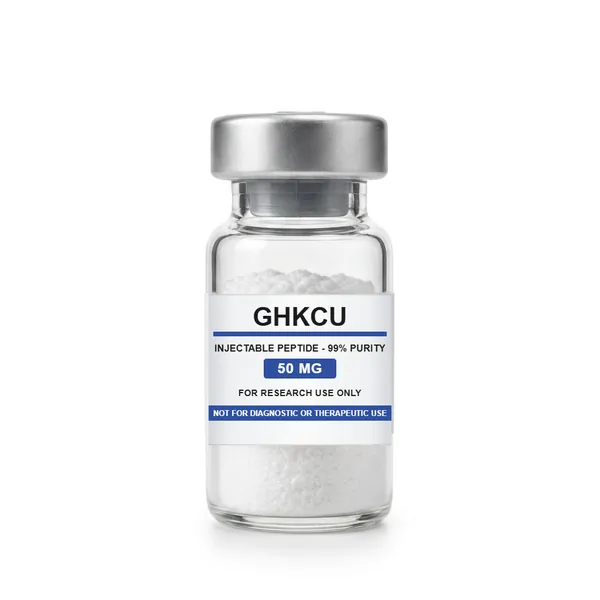
Information for institutional quotation
GHK-CU: price, documentation and dispatch in Colombia
GHK-CU sits in the catalog under the copper peptide category for research. In terms of molecular composition, GHK-CU is the copper tripeptide glycyl-L-histidyl-L-lysine. Its commercial page should be read as an evidence map, not as a promise about applications or results. The map begins with the visible reference and presentation, continues through batch documentation available on request, and ends with the laboratory's receiving and storage records. For the buying institution, the purchase decision also requires keeping three figures separate: product price, number of units, and shipping cost. Lead times remain open until quoting. This guide proposes practical controls for organizing those elements, requesting documentation, and leaving an auditable path, without adding formulas, concentrations, manufacturers, origins, or specifications that are not backed by the material actually offered.
Presentations and visible prices
| Presentation | Code | Reference price |
|---|---|---|
| 50mg | CU | US$52 |
| 100mg | CU100 | US$100 |
The price above is the public value per vial. Availability and batch documentation are confirmed before the quotation is accepted.
An evidence map for GHK-CU
The first node of the map is the name GHK-CU. It should appear the same way in the request, the quote, the label, and, when available, the certificate of analysis. The second node is the presentation selected in the catalog, whose current price is shown dynamically. The third is the batch. Without that common identifier, documents may describe a reference without proving they correspond to the unit actually received. The buyer should connect all three nodes before releasing the material into research inventory.
Classifying this reference as a copper peptide helps place it within the catalog, but it does not authorize extrapolating data from other items in the same family. Each batch carries its own evidence. The institution should not copy formulas, CAS numbers, molecular weight, origin, or manufacturer from an outside page to fill gaps. If one of those data points is needed, it should be requested and the documentary response evaluated. A pending field remains pending until verifiable support exists.
Documentation matrix: what exists and what is missing
A simple matrix can have four columns: requirement, expected document, status, and observation. For GHK-CU, the batch COA, if available, is the central document for reviewing identity and purity. Access to the COA is provided on request and subject to document availability. The quote supports presentation, quantity, and value; the logistics confirmation supports destination, rate, and agreed lead time; the intake record supports what actually arrived. None of these documents replaces the others, because each answers a different question.
Status can be "received," "reviewed," "pending," or "not applicable," always with a date and a person responsible. If the COA is received but does not match the batch, it should not be marked as satisfactorily reviewed. If the dispatch time has not yet been confirmed, the matrix should keep it as pending. This language prevents an assumption from becoming a fact simply by being copied across emails, spreadsheets, or inventory systems.
How to review identity and purity without extrapolating
Identity and purity can only be reviewed on the batch COA when that document is available. A responsible review starts by checking legibility and correspondence: reference name, batch identifier, and associated results. It then records exactly what the document states, without rounding figures, combining certificates, or turning a commercial description into an analytical result. This page avoids publishing a fixed percentage because doing so could attribute to every batch a value that only the specific evidence can demonstrate.
If the institution requires a second verification or additional criteria, it should define them within its own quality system. Documentation is provided on request and subject to document availability, and the buyer decides whether what is received meets its internal standard. It is also worth keeping the original file rather than relying only on a forwarded image. An internal file name may include reference and batch, but it should never replace the data contained in the certificate.
Custody conditioned on batch documentation
If the applicable batch documentation declares storage in the 2-8 °C range with protection from light, the laboratory must assign a compatible location before receiving, confirm that the intended monitoring works, and log the intake without unnecessary delay. That condition is not assumed for every batch and must be verified in the available documentation. When several people are involved, a short receiving instruction prevents the package from sitting temporarily in an uncontrolled spot while it is determined who requested it.
The internal label should support traceability without covering the batch or the original identification. It can include intake date, person responsible, and location. Any observation about receiving conditions must be based on observable evidence or an available measurement. This page does not state a packaging method, a temperature indicator, or a stability claim outside the declared range. If those elements are required, they must be requested and specifically confirmed for the shipment.
Logistics with visible variables
Current rates for shipping to Bogotá and elsewhere in the country are listed on the site's shipping information page. To calculate the order, the buyer adds the confirmed value of the units to the applicable rate. If the destination does not match the usual institutional address or requires extra coordination, that must be reported before approval. The destination alone does not describe hours, access restrictions, or who is authorized to receive the shipment. Outside Colombia, this reference ships to 5 countries (Costa Rica, Ecuador, United States, Mexico and Puerto Rico), from US$57; the rate for each country is listed on the site's international shipping page.
Lead times are not confirmed as a general rule; they are set when quoting. Accordingly, this page should not be used to promise an arrival date. The buyer can propose the window it requires and ask for an explicit response. Once confirmed, that date or range should be kept together with the quote. If inventory or route changes, the update should be put in writing so that receiving works from the current version rather than an earlier expectation.
The purchase as a sequence of authorizations
For GHK-CU, a clear sequence can be: presentation selection, unit request, quote review, COA request on request and subject to document availability, verification of the storage declared in the applicable documents, logistics confirmation, and payment authorization. The payment method and total are defined in writing in the quote before payment. Each step should leave a minimal piece of evidence, even if the same person fills several roles within a small organization.
Before paying, the person responsible compares name, presentation, quantity, rate, and total. Afterward, the record is kept with the purchase file. Payment does not replace quality acceptance on receipt, just as an available COA does not prove that the quantity delivered is correct. Warranty terms are found through the specific link that accompanies the commercial experience; the terms in force are the ones published there, not a summary added to this explanation.
A record useful for audit
A good record makes it possible to reconstruct the history without interpreting informal conversations. It should show who requested GHK-CU, which presentation was chosen, which batch was offered, what documentation was reviewed, what total was approved, when it was paid, and what was received. If a data point was never confirmed, the record keeps it as pending. That documentary honesty is more useful than an apparently complete table built on unverified values.
GHK-CU is offered exclusively for research and laboratory use. This page is limited to commercial selection, batch evidence, logistics, and custody. The institution determines the relevance of its work within its own approved processes and retains control of the material. The commercial scope ends with an identified, documented, and properly stored delivery; it does not extend to defining applications or interpreting the experimental work.
Frequently asked questions about GHK-CU
How is GHK-CU technically different from the GLOW and KLOW blends?
The difference described here is limited to classification and declared composition. GHK-CU is the copper tripeptide glycyl-L-histidyl-L-lysine. GLOW is a three-peptide blend in one vial: BPC-157, TB-500, and GHK-Cu. KLOW is a four-peptide blend in one vial: BPC-157, TB-500, GHK-Cu, and KPV. All are offered exclusively for research and laboratory use.
Is purity the same across all batches?
A universal figure should not be assumed. Identity and purity can only be reviewed on the COA corresponding to the batch. Access to the certificate is provided on request and subject to document availability; if supplied, it should be checked against the label.
What documents are worth keeping?
Keep the request, the final quote, the logistics confirmation, payment support, the receiving record, and, if available, the batch COA. Together they allow the purchase to be reconstructed; no single document answers every traceability question.
What is the declared storage condition for GHK-CU?
The 2 to 8 °C condition with protection from light only applies if the applicable batch documentation declares it. The institution must verify that documentation and prepare and monitor the indicated space according to its own internal procedures.
What does shipping to Bogotá and other cities cost?
Current rates for shipping to Bogotá and elsewhere in the country are listed on the site's shipping information page. Confirm the total if there are multiple addresses, receiving restrictions, or special conditions. Outside Colombia, this reference ships to 5 countries (Costa Rica, Ecuador, United States, Mexico and Puerto Rico), from US$57; the rate for each country is listed on the site's international shipping page.
When does GHK-CU arrive?
Lead times are confirmed when quoting and should not be assumed from the rate alone. State the window required and wait for a written acceptance before arranging receiving around a specific date.
How is an institutional order paid?
Payment is made after confirming, in writing, the reference, presentation, units, destination, shipping, total, and the chosen payment method. The institution should keep the payment support and link it to the same documentary file for the batch.
Where are the warranty conditions reviewed?
They are reviewed at the warranty link published on the site. If a discrepancy arises, keep the packaging, documents, and receiving record, set the unit aside, and request a review before using it in laboratory work.